My hormone is called ACTH, also known as corticotropin. It is produced in the anterior pituitary gland, which is a major organ of the endocrine system. The endocrine system is a collection of glands that produce hormones directly into the circulatory system. ACTH is a component of the hypothalamic pituitary adrenal axis, also known as the HPA Axis. It is a set of three endocrine glands: the hypothalamus, the pituitary gland (which ACTH is apart of) and the adrenal. The HPA axis controls reactions to stress and regulates different body processes like digestion, the immune system, and emotions. ACTH is apart of a negative feedback loop. It is produced in response to stress. When someone is in a very stressful situation, impulses from organs pass to the brain and then to the hypothalamus which is apart of the HPA Axis. The hypothalamus then influences the pituitary gland to create more ACTH. ACTH then stimulates the external layer of the adrenal glands and produces cortisol. ACTH is water soluble and regulates the levels of the hormone cortisol. High cortisol levels can be an indication of Cushing’s disease which is caused by a tumor in the pituitary gland. Someone with high cortisol levels has high blood pressure. People with low cortisol levels could have Addison’s disease, where the pituitary gland is unable to produce enough hormones. Low cortisol levels lead to low blood pressure. MCR is a family of receptors that regulate types of hormones. MCR is the receptor for ACTH, and regulates the entire adrenal. So, ACTH regulates the production of cortisol and is produced in response to stress.
Monday, March 3, 2014

Sunday, February 23, 2014
Friday, February 14, 2014
Cell Respiration Lab: How Honey Effects Yeast
Abstract: In this lab, we will observe the effect of honey on the process of cellular respiration performed by yeast. Sugar influences cell respiration greatly. Yeast can convert sucrose into glucose and use it during respiration. The most sugar in the test tube will create the greatest concentration of CO2 gas from respiration.
Introduction/Background
In this lab, we experiment with yeast. Yeast is a type of fungus that relies on sugar to provide it with energy so it can grow. Like bacteria, yeast can grow in or on their food source. Once they absorb the sugar, they can break down the molecules into monosaccarides and create ATP (energy). This process is called cellular respiration. Yeast can convert sucrose and fructose into glucose and use it during respiration. The first step of respiration is Glycolysis which occurs in the cytosol. Glucose (6 carbon sugar) is broken down into pyruvate (3 carbon molecule.) The second step is the Krebs cycle that takes place in the mitochondria.This is where the cell generates chemical energy (ATP) from oxidation of pyruvate. The last step is Oxidative phosphorylation which occurs in the inner mitochondrial membrane. This is when large amounts of ATP are released. In cases where there is no oxygen to perform glycolysis, yeast goes through the process of fermentation which makes it possible for ATP to be produced without oxygen. Fermentation regenerates NAD that is needed to take part in glycolysis, allowing it to create more ATP. These processes are necessary for life. Yeast produces carbon dioxide from the break down of glucose. In the lab, we add honey to the yeast. There are 3 monosaccharides that make up honey: fructose, glucose, and sucrose.
Hypothesis: Since honey has sugar in it, if it is added to the yeast, the yeast will convert the sucrose and fructose into glucose during respiration. The most honey in the test tube will create the greatest amount of CO2 gas from respiration.
Materials:
4 tubes
4 CO2 measuring pumps
Yeast
Sucrose
Warm water
Salt
Honey
Timer
Procedure:
1. Set out 4 tubes and each tube add 1g yeast, 1g sucrose, and .1g salt
2. Add warm water to all of the tubes and honey to 3 of the tubes
Tube #1- 35 mL water
Tube #2- 34 mL water, 1 mL honey
Tube #3- 32 mL water, 3 mL honey
Tube #4- 30 mL water, 5 mL honey
3. Cap the tubes and shake them all at the same time
4. After it is dissolved, uncap the tubes and let the tubes sit for 5 minutes.
5. Plug each tube with a CO2 measuring pump. Make sure the pump is set at 2 mL.
6. Every minute, mark where the base of the pump is at.
Results: CO2 Measuring Pump- Recording of each tubes CO2 every minute


 Conclusion: Yeast needs glucose to perform cellular respiration. The more glucose there is, the higher energy supply there is for respiration, and the more carbon dioxide produced. So, since honey is mostly made of sugar, the tube that had the most honey (#4 had 5 mL of honey) skyrocketed up the measuring scale. Our control (#1) only had the 1g of sucrose which allowed it to get up to 3.7 mL of CO2. Test tube #2 had 1 mL of honey and went up to 4.2 mL of CO2. Test tube #3 had 3 mL of honey and went up to 5.8 mL of CO2. As you can see, sugar majorly influences the rate of cell respiration in yeast. Our control was tube #1 and the variable was the honey. A potential source of error would be not uncapping the tubes which would not let the yeast get any oxygen to perform glycolysis.
 Wednesday, February 12, 2014
2/5 Jello Lab!!!!!!!!!!
Jello is made of collagen (protein) which comes from cow and pig bones, hooves and connective tissue. Collagen is all over our body. Manufacturers grind up the parts and treat them with a strong acid/base to break down the cellular structures and release proteins (like collagen) Then it is boiled, and the collagen is partially broke down and the result is gelatin. Collagen gives jello the ability to gel.
Pineapple can be added to the jello desert. Real pineapple contains an enzyme called bromelain.
On the directions for jello, it says not to use fresh pineapple, and instead use canned. We designed an experiment to explain why certain types of pineapple work and why some do not.
Experiment- Canned or fresh pineapple- How the enzyme bromelain effects collagen in jello.
We had three trays of jello.
#1: Regular Jello
#2: Jello with canned pineapple- Does gel
#3: Jello with fresh pineapple- Does not gel
Fresh pineapple contains the enzyme bromelian which can separate amino acids. So, since collagen is a protein, when fresh pineapple is used, the bromelian breaks up the collagen in the jello and does not allow it to set and gel.
Canned pineapple has been heated by manufacturers during the canning process. Once the enzyme, bromelain is heated, it is neutralized (denaturalized) and completely changes it shape forever. It will not be able to fit back into the operon system, and will not work. Bromelain then cannot break up the collagen in Jello and the jello will be able to set and gel.

Pineapple can be added to the jello desert. Real pineapple contains an enzyme called bromelain.
On the directions for jello, it says not to use fresh pineapple, and instead use canned. We designed an experiment to explain why certain types of pineapple work and why some do not.
Experiment- Canned or fresh pineapple- How the enzyme bromelain effects collagen in jello.
We had three trays of jello.
#1: Regular Jello
#2: Jello with canned pineapple- Does gel
#3: Jello with fresh pineapple- Does not gel
Fresh pineapple contains the enzyme bromelian which can separate amino acids. So, since collagen is a protein, when fresh pineapple is used, the bromelian breaks up the collagen in the jello and does not allow it to set and gel.
Canned pineapple has been heated by manufacturers during the canning process. Once the enzyme, bromelain is heated, it is neutralized (denaturalized) and completely changes it shape forever. It will not be able to fit back into the operon system, and will not work. Bromelain then cannot break up the collagen in Jello and the jello will be able to set and gel.
Sunday, February 2, 2014
Forensics Quiz
A twenty-year old man was found supine on Thompson Creak Trail with a bullet would. The entrance of the wound was on the left lateral side 1 cm above the third rib. The exit wound was 5 cm above the belly button in the umbilical region. While tracing the bullet path you notice at the entrance the bullet travels in the frontal plane with a 45-degree downward angle. On inspection of the right side of the rib cage by x-ray you observe the 8th rib fractured. Fragments of the bullets are then traced to the final exit wound. What is the leading differential diagnosis (and why) and what are three plausible alternatives and how would you rule them out.
Leading cause of death: Blood loss
-Went to the 3rd rib on left lateral side where the heart is
Most likely severed arteries causing internal bleeding
Alternatives
1) Shock
Would of happened after the heart was hit
2) Lung puncture
Would of happened after the heart was hit, since it was going at an angle
3) Punctured fluid organs which lead to poisoning
Once again, would have happened after the heart was hit
Leading cause of death: Blood loss
-Went to the 3rd rib on left lateral side where the heart is
Most likely severed arteries causing internal bleeding
Alternatives
1) Shock
Would of happened after the heart was hit
2) Lung puncture
Would of happened after the heart was hit, since it was going at an angle
3) Punctured fluid organs which lead to poisoning
Once again, would have happened after the heart was hit
Sunday, January 26, 2014
1/27 Cloning Plants
There are three different ways a plant can clone.
1. Plants clone themselves.
A strawberry plant grows a stem called a runner and a new plant grows from the runner. That new plant is a clone. Similar cloning happens with grass, potatoes, and onions.

 There are a number of diseases that affect banana plants. Tissue Culture is used to produce bananas the are free from disease. Some plant nurseries have a banana planting area based on tissue culture.
2. People clone plants
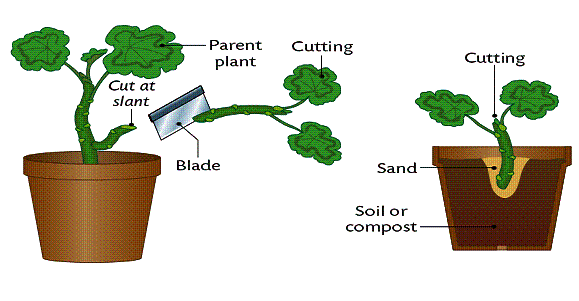
Vegetative Propagation is simply done by cutting a plant's stem and planting it into the earth.
3. Scientists clone plants
Scientists use a method called Tissue Culture Propagation where they take pieces of roots and break them up into root cells and put the cells into a nutrient. (Cell Culture- cells are grown under controlled conditions, outside of their natural environment)
In Culture, the cells become calluses (mass of unorganized cells drives from plant tissue) They are the cells that cover a plant wound.
Specific plant hormones stimulate the cell division which allows the plants that are identical to the original plant to grow. They divide and form different cells like the roots and stems and eventually form a new plant.
Bananas
There are a number of diseases that affect banana plants. Tissue Culture is used to produce bananas the are free from disease. Some plant nurseries have a banana planting area based on tissue culture. Wednesday, January 22, 2014
1/21 Stem Cells/ "Your Inner Healers" Article
There are two different types of stem cells- adult stem cells and embryonic stem cells
Adult stem cells are stem cells after embryonic development and are found in different tissues throughout the body.
They are assigned to a specific tissue and are designed to maintain it.
Their ability to divide is limited.
Embryonic stem cells are at the blastocyst stage. The stem cells are isolated and divide/replicate.
They are able to become any type of cell in the body.
Scientists grow embryonic stem cells. They use a lot of methods and procedures to create them. They have created "recipes" for differentiation: where the embryonic cell is assigned to a important cell in the body (heart, liver, muscle cell)
If scientists can assign the cells to specific cell types, then the cells can treat for disease.
In the article, scientists have found a way to take a adult cell and make it behave like an Embryonic cell. They use manipulations to trick the cell. This process is called cellular reprogramming.
The closest scientists got to that was somatic cell nuclear transfer/cloning where they put an adult cell's DNA into an egg cell.
Adult stem cells are stem cells after embryonic development and are found in different tissues throughout the body.
They are assigned to a specific tissue and are designed to maintain it.
Their ability to divide is limited.
Embryonic stem cells are at the blastocyst stage. The stem cells are isolated and divide/replicate.
They are able to become any type of cell in the body.
Scientists grow embryonic stem cells. They use a lot of methods and procedures to create them. They have created "recipes" for differentiation: where the embryonic cell is assigned to a important cell in the body (heart, liver, muscle cell)
If scientists can assign the cells to specific cell types, then the cells can treat for disease.
In the article, scientists have found a way to take a adult cell and make it behave like an Embryonic cell. They use manipulations to trick the cell. This process is called cellular reprogramming.
The closest scientists got to that was somatic cell nuclear transfer/cloning where they put an adult cell's DNA into an egg cell.
Subscribe to:
Posts (Atom)